The law and your back yard can give different answers to how many ADUs you can build. Start with the law.
News · September 29, 2026 · From January 1, 2027, California cities must approve one converted and two new detached ADUs per single-family lot, within state limits. [1]
That's three ADUs on one lot: one made from existing space (part of the house, or a garage or shed), plus two new detached ones [1][2][3][4]. With the main house, that's four homes [1].
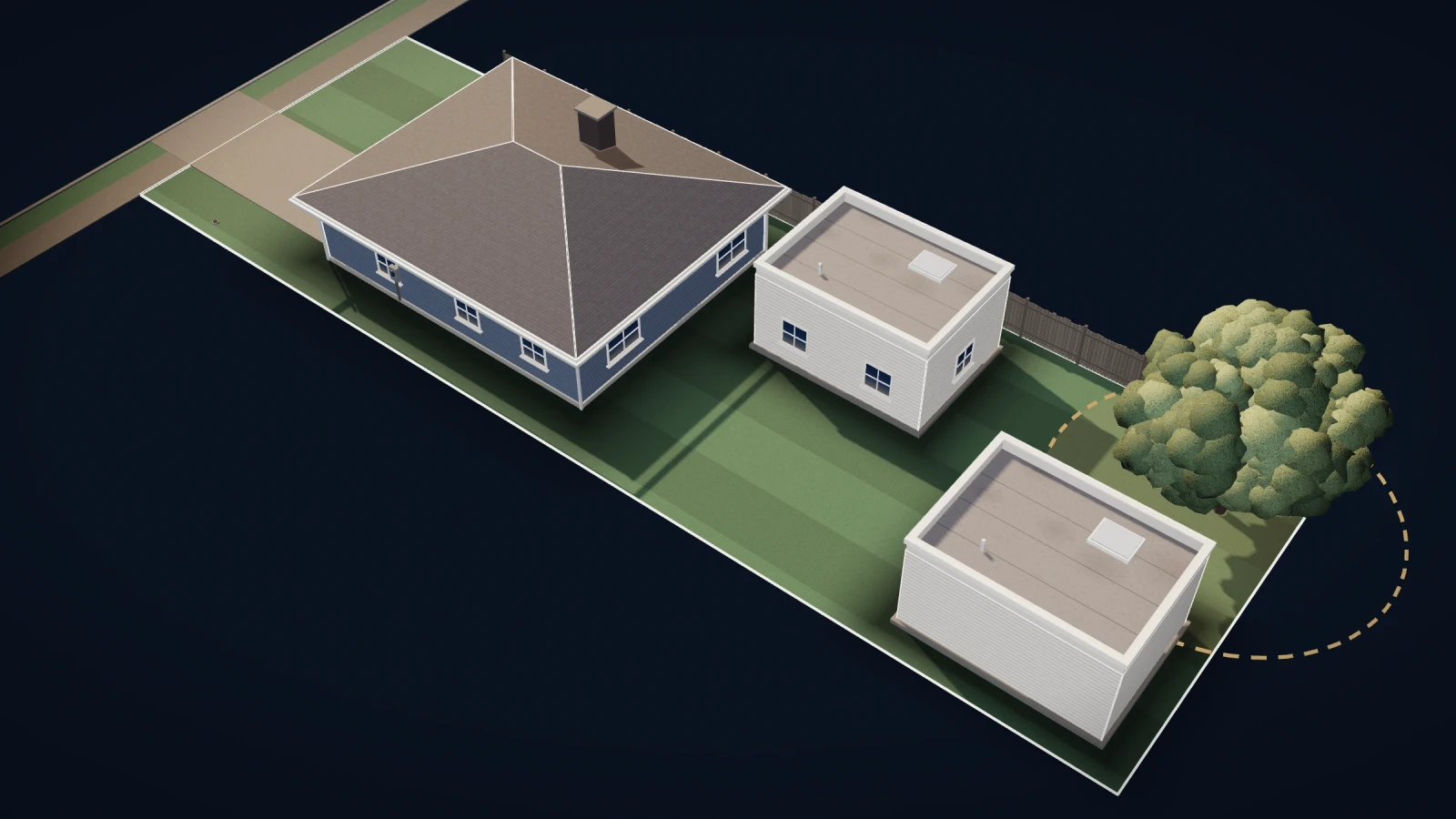
Then ask the yard, because on many lots it runs out before the law does. On the example lot below, 50 by 150 feet, one cottage fits easily. The second would likely need sprinklers, the fire agency's OK for the longer hose path, or a different layout. And some rules stop at two: Menlo Park Fire's longer, sprinklered hose path is written for driveways serving one or two homes, and a house with two cottages makes three [20].
How many ADUs does California allow from January 2027?
Under Government Code §66323, as AB 956 amends it, a city must approve any combination of these on a lot with a house [1]:
One ADU converted from existing space, inside the house or an existing accessory structure such as a garage. A converted garage or shed may grow up to 150 square feet, only to make room for getting in and out [3].
Two new detached ADUs, with side and rear setbacks of no more than 4 feet [1].
Two paths, two size limits. On this state path, a city may cap each new detached ADU at 800 square feet. It must allow at least 16 feet of height, and more near major transit [1][3]. A bigger unit, up to a city's own cap (Palo Alto plans to raise its cap to 1,200 square feet [5]), goes through the city's own ADU rules instead. Before AB 956, HCD said a city must also allow one ADU under its own rules on top of the state-path units [3][4]. How that works with a second detached ADU isn't settled, so ask before you design one. A converted ADU has no city size cap: it stays within the existing walls, plus up to 150 square feet for getting in and out [1][3].
A junior ADU becomes the city's choice. Once two detached ADUs have been built, the city no longer has to approve a junior ADU on that lot, though it may [1].
Parking rarely stops it. A city can't make you replace the parking when you convert or tear down a garage for an ADU, and it can't require a space within a half-mile walk of public transit [3].
Do your city's posted ADU rules still apply?
Not always. In 2024, the state housing department found that the ADU ordinances of San Mateo, Palo Alto and Burlingame did not comply with state law [6][7][8]. All three have since amended their ordinances [9][10][11], and Palo Alto is working on another update [5]. In December 2025 and May 2026, it told Saratoga, Los Altos and Mountain View that the ordinances it has on file may be out of date [12][13][14]. Since January 2026, a city's ADU ordinance is void if the city misses HCD's deadlines to submit or answer, and state law applies instead (SB 9 of 2025) [15].
Rules move, too. Menlo Park adopted a new ADU ordinance on June 9, 2026 [16]. City handouts can be stale: San Mateo's own ADU FAQ still says "one ADU or JADU is allowed per parcel" [17], while its Ordinance 2026-02 allows a conversion or attached ADU, a new detached ADU and a junior ADU together [9]. Our San Mateo guide covers that city's rules. Get the city's answer in writing, with the code sections it cites, before anyone draws.
Example: how many ADUs fit on a 50-by-150-foot lot?
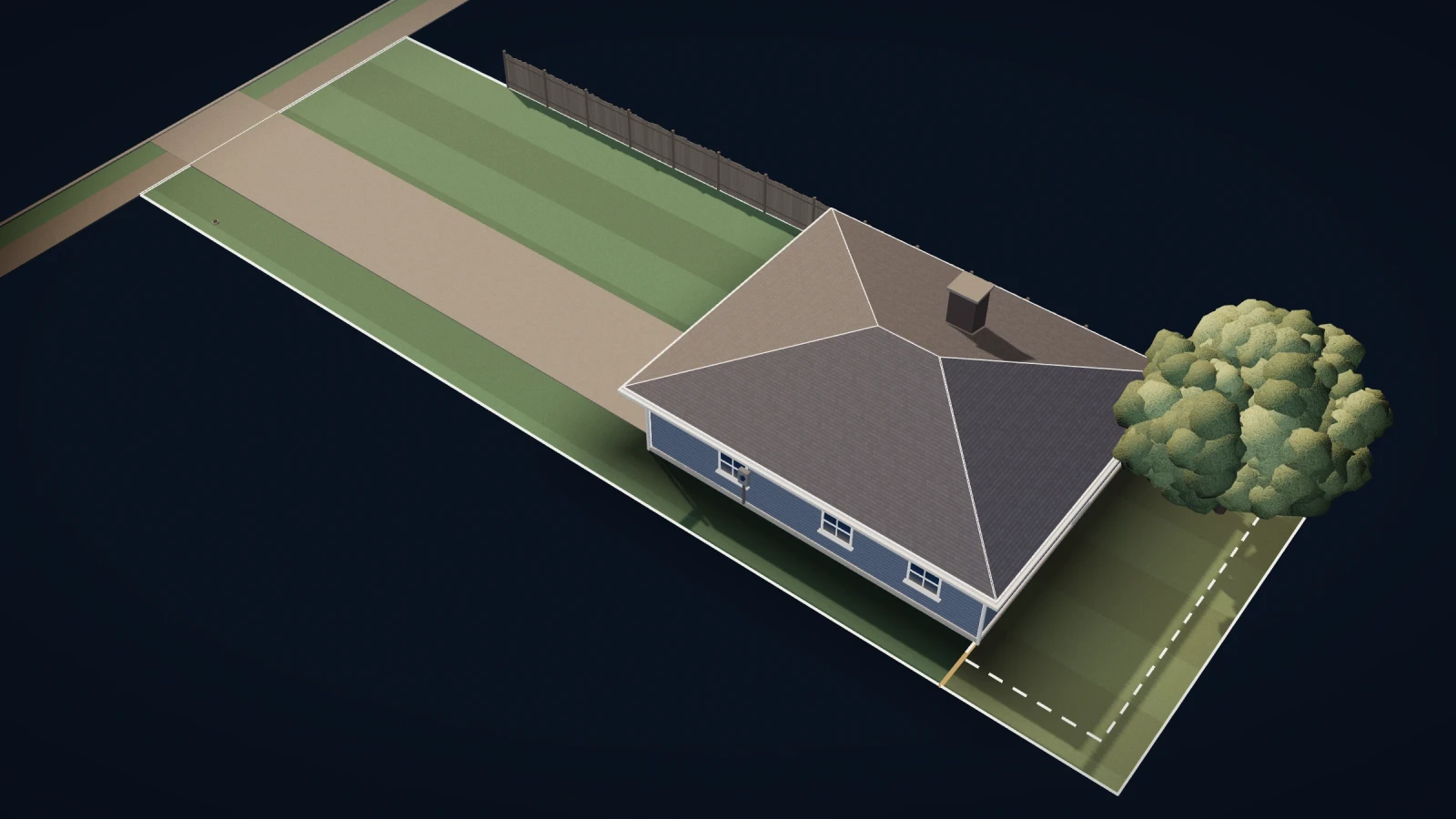
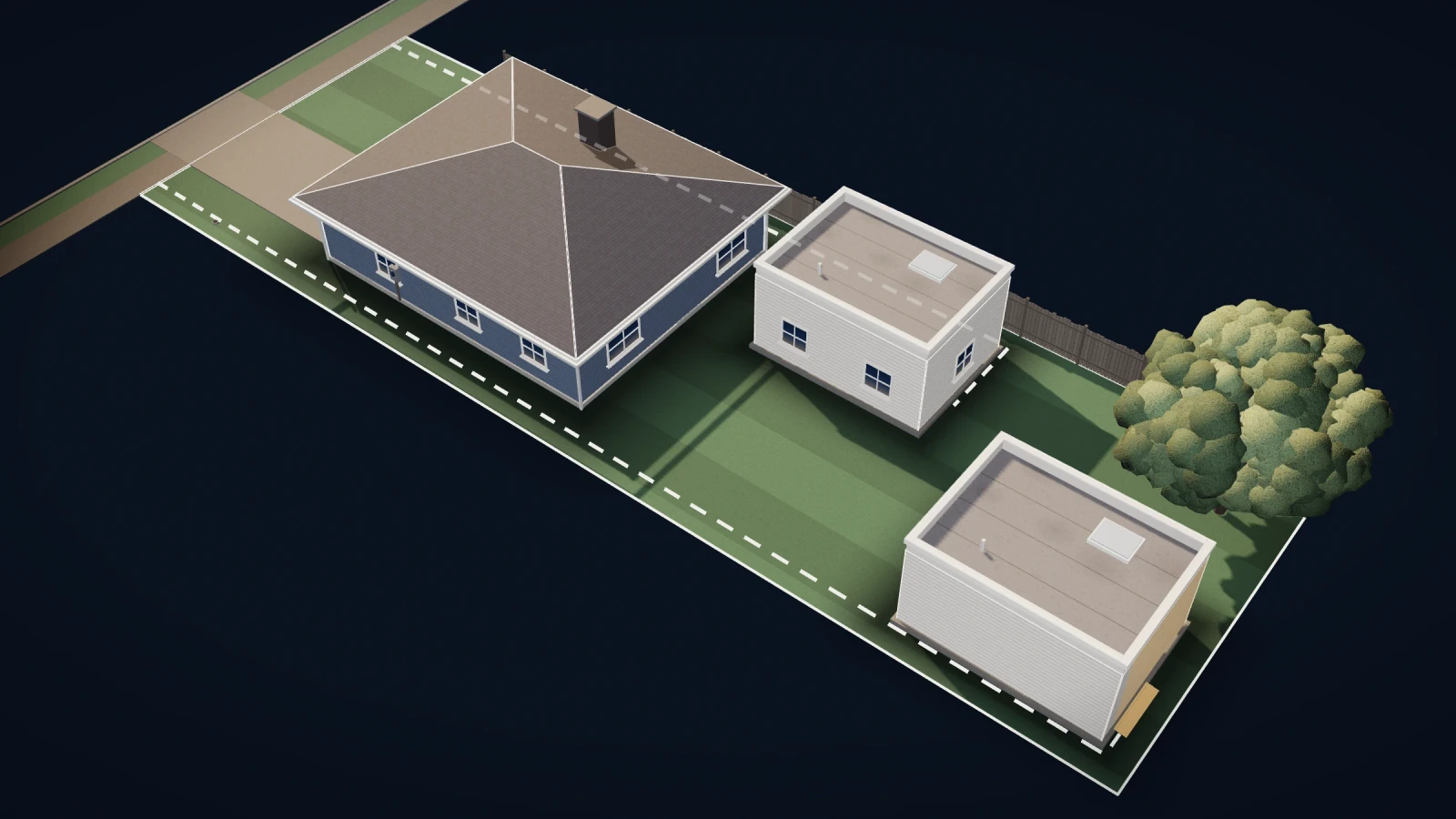
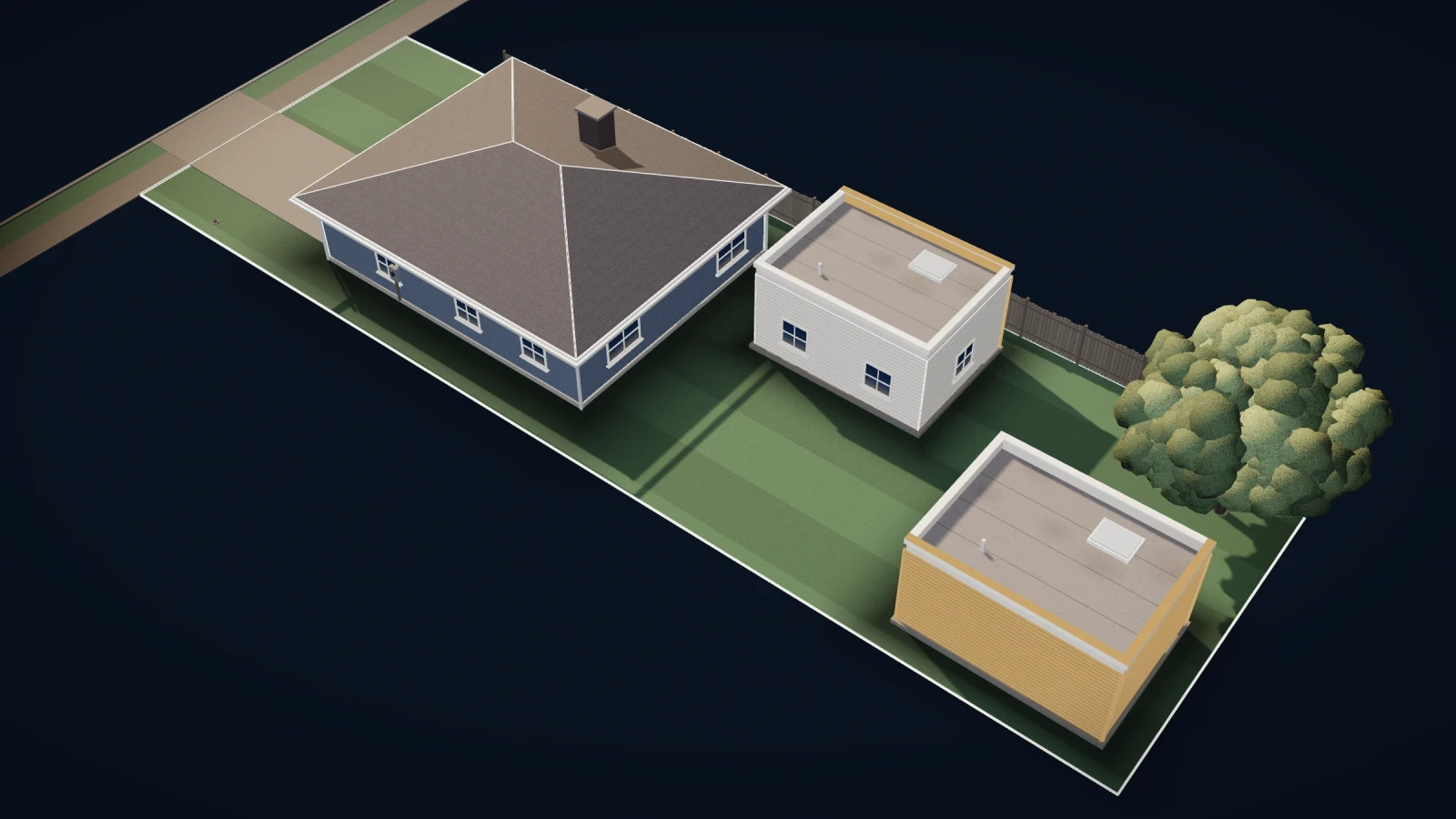
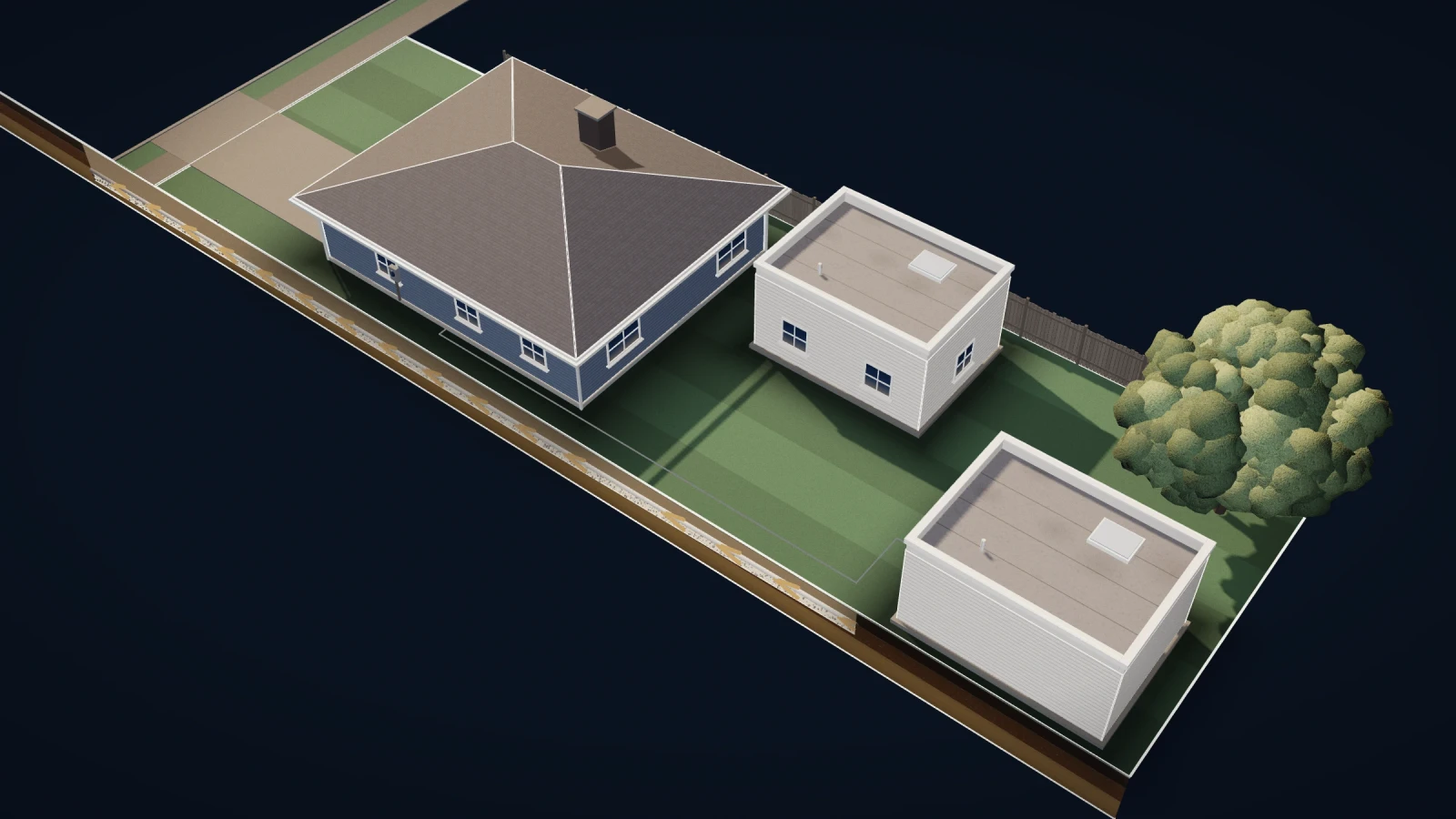
On this example, one cottage fits easily and the second sits partly past the 150-foot hose limit. The lot is 50 feet wide and 150 deep, with a 36-by-44-foot house. The rear yard rule is 20 feet, as in Palo Alto and Menlo Park [18].
The strip. A cottage may sit 4 feet from the back line [1]. A house built right to its 20-foot line would leave a strip only 16 feet deep. Our example house sits farther forward, with 75 feet of yard behind it.
The first cottage fits behind the house, 10 feet off its back wall.
The second cottage goes in the back corner, diagonally behind the first. Every first-floor outside wall must be within 150 feet of the fire department's access road, usually the street, measured along the path around the building [19][20]. On our example, every wall of the first cottage is within about 130 feet by the nearest side yard. The middle of the second cottage's back wall is about 156 feet away by the shortest route, past the line. Menlo Park Fire can allow 200 feet, measured straight from the street to the home, when the farthest home is sprinklered and under 3,600 square feet. But that allowance is written for one or two homes, as above, so ask [20].
Walls near the line. A wall less than 5 feet from a lot line (3 feet if the building has sprinklers) must be fire-rated, and two homes on one lot are treated as if a line ran between them. Without sprinklers, windows are limited too: a quarter of the wall between 3 and 5 feet, and none closer than 3 [21]. On our example, that's one wall of the first cottage and two of the second.
Underground. A sewer line usually needs at least a quarter inch of fall per foot, or an eighth for 4- to 6-inch pipe where a quarter inch isn't practical and the building department approves [22]. Over 100 feet of yard, a quarter inch adds up to about 2 feet of drop, and a cottage that sits too low needs a pump. If two new homes need a bigger electrical service, the state's target for PG&E's own steps on a new service line is 182 days on average, counted from a complete request [23].
Trees. Menlo Park protects native oaks from 10 inches across, San Mateo any oak from 10 inches, and both protect other trees from 15, all measured 4½ feet up the trunk [24][25]. On one of our San Mateo jobs, the footing forms stop right at the tree protection fence.
The verdict on this example: the law allows two, and the yard takes one easily. Your lot will answer differently, which is why it pays to check first.
How much are ADU fees from 2027, and what can an ADU earn?
Fees shrink in 2027. Above 750 square feet, a city's impact fees on an ADU are a share of what the main house would pay, scaled to the house's size [3][26]. So the same cottage can owe more next to a small house than next to a big one. From 2027, for up to two ADUs on a lot, only the area above 750 square feet is charged [26]. An 800-square-foot unit would be charged on 50. With three ADUs on the lot, that break doesn't apply: impact fees on a unit over 750 square feet can be charged on all its area, still scaled to the house's size, and one of 750 or less still owes none [26].
Other charges stay. In the city of San Mateo, the high school district lists school fees of $5.02 per square foot (2026), which covers the elementary district too [27], and Palo Alto's district lists $4.79, its 2022 rate [28]. In 2024, CBS reported that Montara's water district required a separate water line and meter for new ADUs, which one contractor put at $15,000 to $20,000 [29]; state law bars that for conversion and junior ADUs [26].
What it can earn. As of October 2026, HUD's benchmark studio rent, utilities included, is $2,574 a month in the San Francisco area, which includes San Mateo County [30]. In the San Jose area, HUD's new figure is on hold after local housing agencies asked HUD to recheck it, so last year's $2,621 still applies [31][32]. HUD sets these at the 40th percentile of standard rentals [33]. Both counties assess a new ADU on its own added value, partly while it's being built and fully once it's finished, and the house isn't reappraised [34][35].
Two cautions: garage rebuilds and PG&E delays
A conversion permit doesn't cover a rebuild. In East Palo Alto, an owner's garage-conversion ADU permit was revoked after the entire garage and its foundation were removed. The city council denied his appeal 4–1 [36]. If the old structure has to come down, get the permit for what you'll actually build.
The utility can add months. The Chronicle reported a San Francisco homeowner who spent about nine months dealing with PG&E's permits, inspections and work to add a second meter for his basement ADU. PG&E says its backlog of design requests for new service fell from six months in 2023 to under one month by the end of 2024 [37].
How to check how many ADUs fit on your lot
Gather the lot facts: size and depth, how far the house sits from the back line, the trees, and where the sewer line and electric meter are.
Measure the hose path from the street to the back corner, along the side yard you'd use.
Ask in writing. Ask the city which ordinance and code sections it applies, and whether it will approve a junior ADU with two detached ones. Ask the fire agency where it measures from and what it accepts beyond 150 feet.
Price the site, not just the building: sewer, power, water and sprinklers if needed.
Amiari Construction builds ADUs and additions on the Peninsula.
How we checked this: In October 2026, Amiari Construction read the laws in the legislature's own records and checked HCD's letters, city ordinances and FAQs, the fire, building and plumbing codes, tree rules, school fees, HUD rents, tax rules and news reports.