News · January 28, 2026 · The State Allocation Board raised the Level I cap on school fees for residential construction to $5.38 a square foot, from $5.17, effective immediately. [1]
The usual math goes like this. A builder gives a price, someone says a cottage rents for $3,000 a month, and the owner divides one by the other. The answer looks good. It leaves out the fees, the new tax bill, the months before the first rent check, and a question about land that decides what the cottage is worth when the house sells.
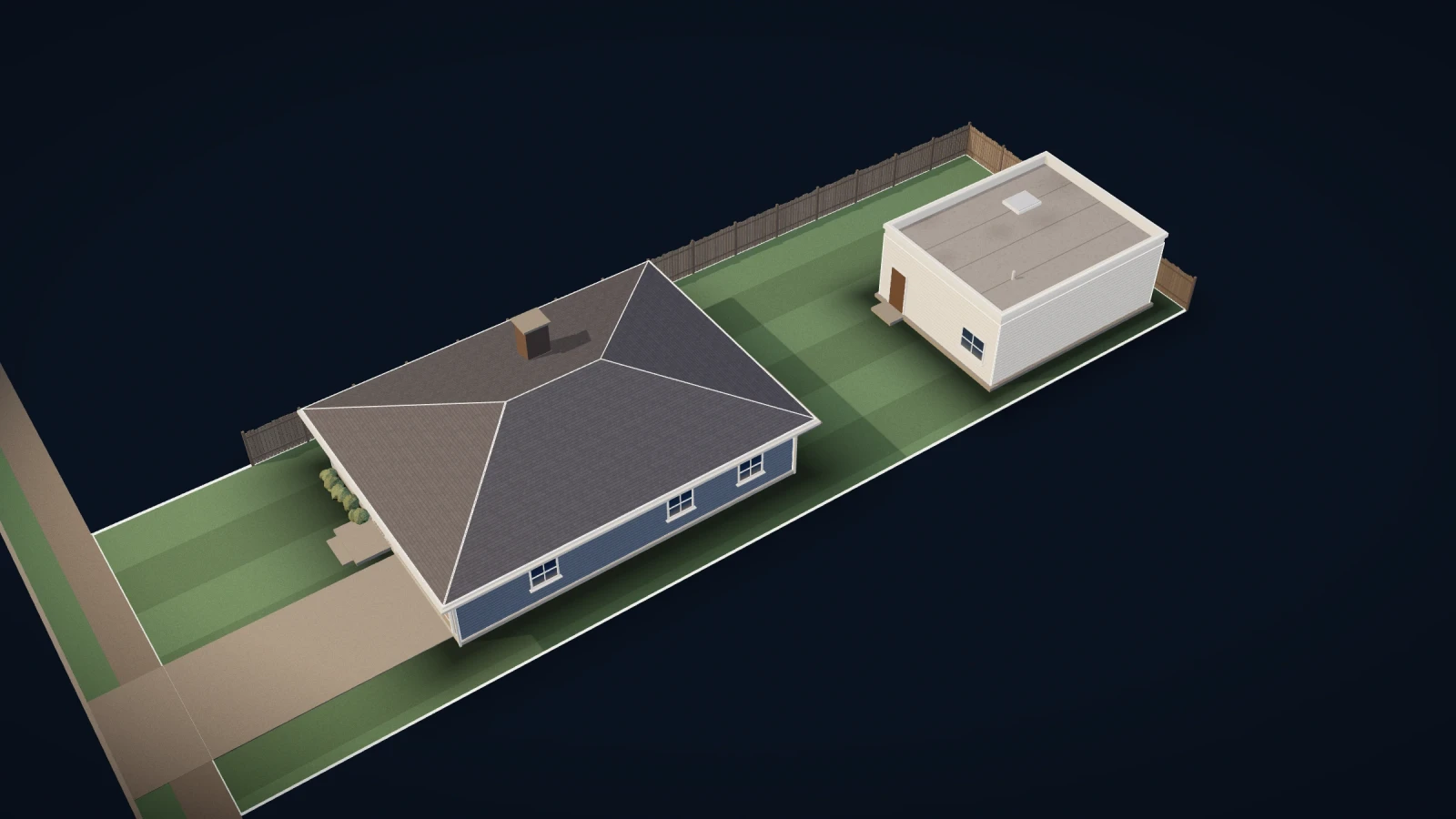
Take an example: an 800-square-foot cottage behind an 1,800-square-foot house in San Mateo.
How much does an ADU cost per square foot?
There's no official price per square foot for an ADU, but the counties publish starting points. Santa Clara County's ADU program tells owners to begin with "a very rough placeholder" of $400 to $550 per square foot for construction, design and fees together, and $150 to $500 for construction alone, with the low end for a junior unit made from space inside the house [2]. San Mateo County's own workbook, from 2018, put most projects at $250 to $500 per square foot of construction, in 2018 dollars [3]. A 2021 UC Berkeley survey of ADU owners found the Bay Area the most expensive region, with a median construction cost of $177,500, or $329 per square foot [4]. A small cottage may cost nearly as much as a larger one, because the kitchen, the bath and the foundation don't shrink much with the floor plan [2].
Even building departments disagree. To set permit fees, San Mateo values a new wood-frame home at roughly $520 to $555 a square foot, and San Carlos uses $232 [5][6][7].
At Santa Clara's placeholder, our example comes to $320,000 to $440,000. That's a public planning figure, not a bid.
How much are ADU fees, before and after January 2027?
For our example, San Mateo's 2026-27 schedule and its school district add [5][8]:
a flat ADU building permit fee of $2,831.57;
transportation and child-care impact fees of about $3,100 to $5,300, depending on whether the city counts the cottage as a single-family or a multifamily unit [9];
school fees of $5.02 a square foot, about $4,000, measured to the outside of the walls, so a little more [10];
a sewer capacity charge of $5.87 a square foot, or $4,696.
PG&E's average invoice for an ADU's new electric service is $4,831.86 [11], and the trenching on your property is yours on top [12].
From January 1, 2027, the impact fees shrink. State law already exempts an ADU with 750 square feet or less of living space inside, and limits a bigger one to a share of a new house's fees, scaled to the house's size [13][9]. SB 1117 counts only the living space above 750 square feet, for up to two ADUs on a lot [14]. Our cottage is charged on 50 square feet: about $200 to $330 instead of $3,100 to $5,300 [9]. School and sewer charges don't change. A school district may charge on all of the new space once it's more than 500 square feet, and January's increase raised the basic cap to $5.38; some districts qualify to charge more [15][1][10]. Together, these items come to about $20,000 to $22,000 today and about $17,000 in 2027, before any charges the city sets as a share of construction value [5].
How much value does an ADU add?
Less than a home's price per square foot suggests. Here's the comparison owners hear most. In the third quarter of 2026, single-family homes sold for a median of $1,345 a square foot in San Mateo, $1,309 in Redwood City and $2,188 in Palo Alto [16][17]. Against $400 to $550 to build, the cottage looks worth about three times what it costs.
It isn't, for two reasons. First, that price includes the land, and on the Peninsula the land is most of the value. An experimental FHFA estimate for 2022 puts it at about 71% of single-family property value in San Mateo County and 69% in Santa Clara County [18]. Take the land out and the building part of a San Mateo house is worth roughly $390 a square foot, about what the counties tell owners to budget, or less. A cottage adds floor area, not land.
Second, lenders' appraisers don't add a detached ADU to the house's living area. Fannie Mae has the appraiser report it on its own line, and FHA says the appraiser "must not add an ADU" to it [19][20]. Freddie Mac asks for at least one comparable sale with an ADU, and lets the appraiser use an older one if no recent sale exists [21]. A peer-reviewed Los Angeles study found an ADU raised a property's selling price by 7 to 9 percent [22].
What an ADU rents for, the tax it adds, and the payback
HUD's Fair Market Rent for a one-bedroom in San Mateo County is $3,003 a month in its fiscal 2027 figures [23], in effect from October 1, 2026 [24][25]. That's HUD's estimate of the 40th-percentile rent, utilities included, that recent movers pay, not a forecast for a new cottage [24]. HUD received a valid request to recheck the San Francisco area's figures, so they may change [25]; it says revised figures from its rechecks will be posted in April 2027 [24]. At $3,003 a month, our example grosses about $36,000 a year.
The assessor adds the cottage's market value to your assessment when it's finished, and the house and land aren't reappraised [26][27]. A supplemental bill covers the rest of that tax year, and if the cottage is finished between January and May, a second one covers the next full year [26][28]. In San Mateo's main tax rate area the rate was 1.1201% in 2025-26 [29], so if the assessor adds $400,000, the bill rises about $4,480 a year. Rent is taxable income. The IRS lets owners deduct expenses and depreciate the building, not the land, over 27.5 years [30].
So before vacancy, upkeep, insurance, financing and income tax, our example nets about $31,500 a year. Recovering the $320,000 to $440,000 the county placeholder implies, fees included, takes roughly 10 to 14 years of rent.
The clock also starts late. In the state's housing reports, the ADUs permitted in 2021 and 2022 whose finish dates were recorded took a median of about 15 months from building permit to final sign-off across 11 of our 12 cities. San Mateo's own median was about 9 months, and Saratoga's recent reports don't record finish dates [31]. PG&E's own average for an ADU's new electric service was 303 days from application to power [11].
Can you sell an ADU separately, or count its rent for a loan?
You can't sell the cottage on its own. State law allows that only where the city adopts a condominium ordinance, apart from a narrow route where a qualified nonprofit built the ADU or the house and the ADU goes to a low- or moderate-income buyer [32][33]. As of October 17, 2026, we found none in our 12 cities, and Palo Alto's planning commission voted in September against recommending one [34]. When you buy, or refinance without taking cash out, lenders count rent from one legal ADU, generally 75% of it and capped at 30% of the income you qualify with; Fannie Mae counts it only from an ADU that already exists [35][36][20]. Freddie Mac allows one ADU per property, and FHA counts a house plus one ADU as a single unit [36][20]. Fannie Mae has allowed up to three ADUs on a one-unit home since March 31, 2026, but only on loans with its new UAD 3.6 appraisal, which becomes mandatory on November 2, 2026, and it counts rent from only one of them [37]. Ask your lender before you build two under the 2027 law [38]. The state's CalHFA grant of up to $40,000 has been fully allocated since December 2023 [39].
How to check whether an ADU will pay on your lot
Your own price per square foot. Compare a real bid with the county's placeholder, and ask what it leaves out.
Every fee at your size. Ask the city, the school district and the sewer agency, for a permit issued before and after January 1, 2027.
The rent. Check it against HUD's Fair Market Rent for your county, knowing what it measures. In Santa Clara County, HUD's 2026 figures stay in effect for now, because local housing agencies asked HUD to recheck the 2027 ones [25].
The calendar. Ask how long your city's ADUs take from permit to sign-off; the median we could track across our cities was about 15 months.
The loan. If you'll borrow, ask the lender how it treats an ADU, and how it treats two.
Amiari Construction builds ADUs and additions on the Peninsula.
How we checked this: In October 2026, Amiari Construction read both counties' ADU guides and San Mateo County's tax rate book and assessor's guidance, San Mateo's fee schedule and its school district's rates, state law in the legislature's own data, the State Allocation Board's fee decision, HUD's rent rules, the Fannie Mae and FHA guides, Fannie Mae's March 2026 appraiser update, Freddie Mac's ADU guidance, FHFA's land data, the IRS's rental guide, and the state's ADU permit records for our 12 cities.