Kitchen remodel permit in California reaches past the cabinets
In a house built by January 1, 1994, a kitchen permit means swapping old high-flow fixtures house-wide, with narrow exceptions, plus alarms and wiring rules.
In a California house built on or before January 1, 1994, the city won't give final approval on a kitchen remodel until every toilet, showerhead and faucet in the house that is over the old water limits has been replaced, with narrow exceptions, and any alteration that needs a permit also means smoke alarms wherever a new home would need them.
New kitchen work follows the 2025 California codes, including ground-fault protection for kitchen receptacles, arc-fault protection for 120-volt kitchen circuits and the Energy Code's rules for changed lighting, while what a replacement range hood must do depends on what earlier permits required.
The state's rule for a future 240-volt range circuit covers new homes only, but Menlo Park and Mountain View enforce their own versions for some kitchen remodels that keep or install gas appliances, and Palo Alto, San Mateo, Atherton, Los Altos and Saratoga have rules whose status you should confirm with the city.
Keeping the gas range? Pick your city
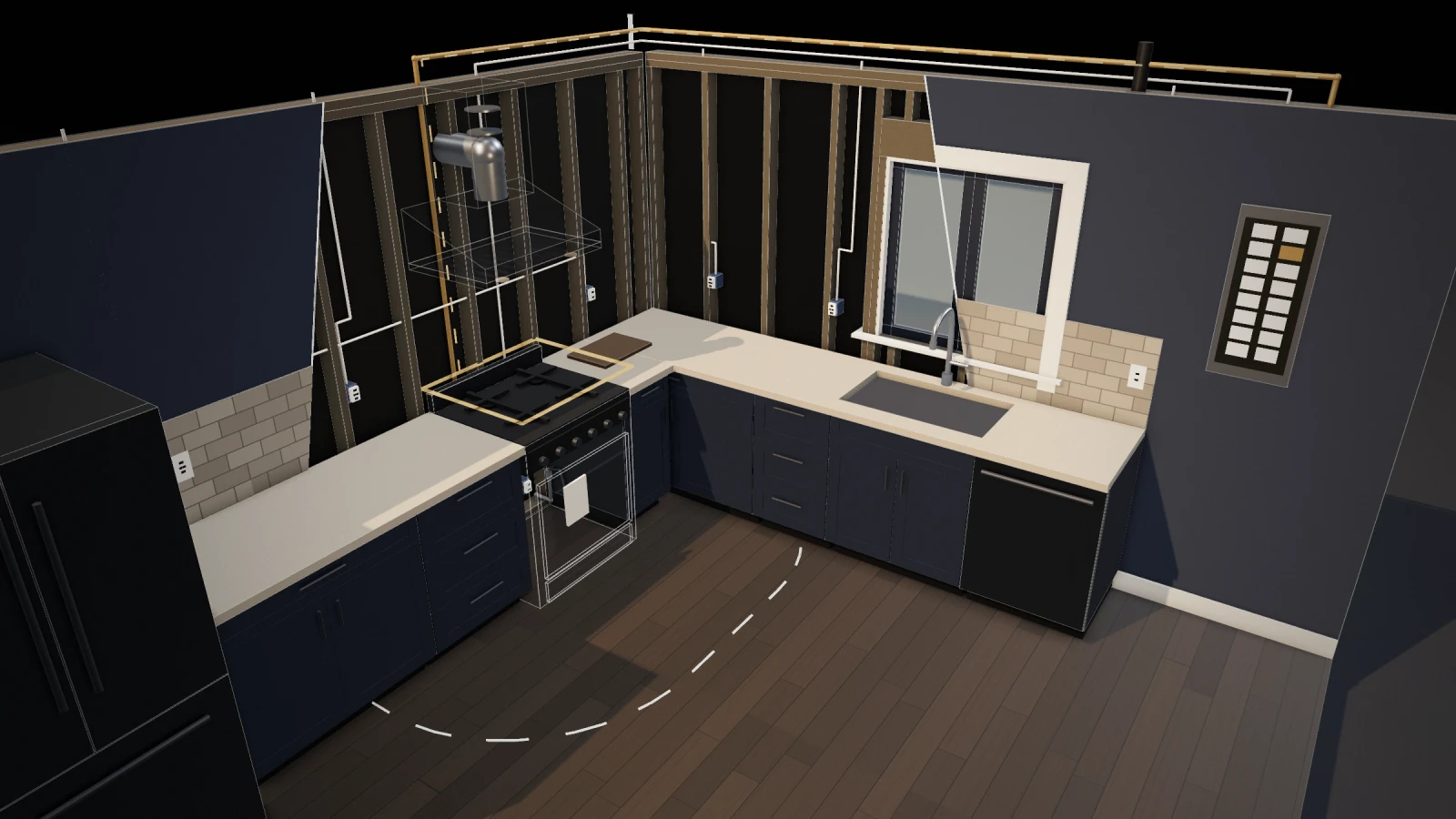
Illustrative drawing
1State rule: new homes only[6]2A few new circuits
No local kitchen rule found [30][31][32][33][34]. The state's 240-volt cooktop-ready rule is written for new homes, not remodels [6].
Illustrative drawing of an example kitchen with a gas range: what each city's rule adds
A kitchen remodel bid usually prices cabinets, counters and appliances. Under the state's residential code, painting, tiling, cabinets, countertops and similar finish work need no building permit [1], though a city can amend that list: Menlo Park's version says "tiling except in showers" [2]. But once the job needs one, the permit can add work nobody drew, starting behind the range.
Keep or add a gas range in Menlo Park, and the permit can call for a pathway to a future 240-volt range circuit [3]. Put in a new or replacement one in Mountain View, and it calls for wiring or conduit and a reserved breaker for a future electric range [4]. Five other Peninsula cities have rules whose status you have to confirm (see the table below) [5]. What a new range hood must do depends on what the house's earlier permits required [6].
And if your California house was built on or before January 1, 1994, the city won't give final approval until, with narrow exceptions, every toilet, showerhead and faucet in it that's over the old water limits has been replaced [7][8][9]. In any house, the permit also brings smoke alarms wherever a new home would need them [10].
An example: a 1960s Peninsula ranch with a gas range, gas heat and an attached garage. The owners redo the kitchen in place, with new cabinets, counters, appliances and lights, and a few new circuits.
Does a kitchen permit reach the toilets and smoke alarms elsewhere?
Under SB 407, California's fixture law, any alteration or improvement to a single-family home built and available for use on or before January 1, 1994 means replacing every "noncompliant" toilet, showerhead and faucet in the house before final approval [7][8][9]. Replacements must meet today's new-home standard [9]: for the new kitchen faucet, 1.8 gallons a minute, with a short boost to 2.2 allowed [11]. Our bathroom permit guide lists the old limits and the narrow exceptions.
Smoke alarms go wherever a new home would need them, including each bedroom, outside the bedrooms and each additional story [10]. Near the kitchen, an alarm must sit at least 20 feet from a permanently installed cooking appliance, or 10 feet for some alarm types, with further exceptions [10].
The example ranch burns gas and has an attached garage, so it has needed carbon monoxide alarms since July 1, 2011, permit or not [12], outside the bedrooms and on every level [13].
So a bid priced for the kitchen alone can grow at final. A complete one lists the alarms the house still needs and, in a house built by January 1, 1994, the failing fixtures elsewhere.
Which GFCI, AFCI and lighting rules apply to new kitchen work?
New kitchen wiring follows the 2025 California Electrical Code, which is the 2023 National Electrical Code with state amendments [14]. Its kitchen rules, each with narrow exceptions:
Every kitchen receptacle rated 125 to 250 volts needs ground-fault (GFCI) protection, including the refrigerator and range outlets [15].
Dishwashers, electric ranges, wall ovens, cooktops and microwaves rated 150 volts or less to ground and 60 amps or less need GFCI too, plugged in or hardwired [15].
Arc-fault (AFCI) protection covers every 120-volt, 10-, 15- or 20-amp kitchen circuit. An existing kitchen circuit the job modifies, replaces or extends needs it too, unless the extension is 6 feet or less and adds no outlets or devices [14].
Kitchen wall, floor and counter receptacles need two or more 20-amp circuits [16].
An island or peninsula no longer needs a receptacle, but without one it needs a provision for adding one later, as the building department defines it [17].
So for each kitchen circuit a bid adds, modifies, extends or replaces, check that it includes the arc-fault and ground-fault protection these rules call for [14][15].
Changed lighting must meet the Energy Code, though lights left alone can stay [6][18]. New lights must be high-efficacy, certified to the state's JA8 standard; new recessed downlights must be airtight, with no screw-in sockets; and kitchen lights need wall dimmers, each with some exceptions [6].
What must a replacement range hood do?
A replacement range hood follows one of three Energy Code paths, depending on what the house's earlier permits required [6]:
If an earlier permit required today's kitchen exhaust rule, the new hood must meet that rule's table: over a gas range in a house of more than 1,500 square feet, 180 cubic feet a minute or 70% capture efficiency.
If an earlier permit required a vented hood or other kitchen fan, the new one must at least match that permit's airflow, or 100 cubic feet a minute if that's more.
If no earlier permit required either, the kitchen exhaust rule doesn't apply.
Any new hood must be rated for airflow and sound, but the code calls for a rater's field check only on a vented hood installed to meet today's rule [6]. The Energy Commission's sample alteration form says every new or replacement hood needs one [19]. Ask the building department which it applies before a bidder prices a rater's visit.
Keeping the gas range? Does your city require a 240-volt line?
California's "electric cooktop ready" rule, a 240-volt circuit of at least 50 amps within 3 feet of a gas cooktop, is written for new homes, not remodels [6]. Some Peninsula cities add their own. A 2025 state law, AB 130, limits new local building rules for homes from October 1, 2025 to June 1, 2031, with exceptions such as rules a city had filed and in effect on September 30, 2025 [20].
News · November 4, 2025 · From January 1, 2026, Menlo Park's Ordinance 1127, adopted November 4, 2025, requires a pathway for a future 240-volt, 50-amp circuit when a one- or two-family kitchen alteration keeps or adds a gas appliance; its scope section lists narrower triggers. [3]
City
Kitchen rule for a permit applied for now
Menlo Park
In force (see the news above) and accepted by the state Building Standards Commission [5]. Its kitchen section requires a 240-volt, 50-amp pathway and reserved panel space in any kitchen alteration keeping or adding gas; its scope section lists only a panel replacement or a new circuit within 3 feet of an existing gas appliance. Ask in writing which applies [3].
Mountain View
In force from January 1, 2026, and accepted by the Commission. A permitted remodel that installs a gas or propane appliance, new or replacement, needs wiring or conduit and a reserved breaker for a future electric version. Rewiring alone doesn't trigger it, and it doesn't apply where it would force a bigger electrical panel than the job needs [4][5].
Palo Alto
City staff list electric readiness when installing gas equipment as already in effect [21]. Kitchen circuits changed or added under a permit need a circuit of at least 50 amps or a 240-volt pathway, plus reserved breaker space; with a gas cooktop that's part of the remodel, expect the state's cooktop-ready rule too [22]. The Building Standards Commission's list doesn't show the ordinance; confirm at plan check [5].
San Mateo
Adopted March 16, 2026, for kitchen circuits added or changed under an electrical permit, but, per the city, still awaiting state approval [23][24].
Atherton, Los Altos, Saratoga
Rules on the books for kitchen circuits added or changed under an electrical permit; in Atherton, for an altered circuit serving a gas range or wall oven [25][26][27][28]. We found no record the state has accepted these kitchen rules; ask in writing [29][5].
Hillsborough, Belmont, San Carlos, Redwood City, Cupertino
No local kitchen rule found [30][31][32][33][34].
Do you need lead or asbestos testing before a kitchen remodel?
The example ranch, built before 1978, is "target housing" under EPA's lead rule [35], so paid work that tears out its painted walls needs a certified firm unless testing under the rule finds no lead-based paint on the parts the work disturbs [36]. From July 1, 2027, the firm and at least one person on site also need a California certificate for that work [37]. Under the Bay Area Air District's rule, an old vinyl kitchen floor would need an asbestos sample before it comes out, unless it's treated as asbestos; ceramic tile itself wouldn't [38]. Our bathroom permit guide gives the district's full sampling list.
Your city adds its own fees, reviews and sewer checks
Fees, fast review and the cost, size or added toilet that brings a sewer lateral inspection (the lateral is the pipe from the house to the public sewer [39]) differ from city to city. In San Mateo, for example, a remodel costing more than $90,000 brings an inspection before the building permit is issued, with exemptions [40][39]. Our 12-city guide puts the fees, review paths and sewer triggers side by side.
Before you ask for bids
Find the year built. On or before January 1, 1994 brings the fixture rule; before 1978 brings the lead rule.
Pull the permit history. Earlier permits decide which Energy Code path a replacement range hood follows.
Ask the city in writing which electric-ready rule applies if the range stays gas, what the permit costs, and whether a sewer lateral check comes with it.
Ask each bidder to price the alarms and fixtures outside the kitchen, the circuits and hood, and the lead and asbestos steps.
Amiari Construction remodels kitchens on the Peninsula.
How we checked this: In October 2026, Amiari Construction read the state laws in the Legislature's records, the 2025 California codes (official texts, except three electrical rules on GFCI, kitchen circuits and islands, read in trade, county and NFPA staff summaries because the official copy needs a sign-in), EPA and Air District rules, and 12 cities' ordinances, fees and state filings.
Step by step
01Find the year builtBuilt on or before January 1, 1994 brings the fixture rule; before 1978 brings the lead rule.
02Pull the permit historyEarlier permits decide which Energy Code path a replacement range hood follows.
03Ask the city in writingWhich electric-ready rule applies if the range stays gas, what the permit costs, and whether a sewer lateral check comes with it.
04Ask each bidderPrice the alarms and fixtures outside the kitchen, the circuits and hood, and the lead and asbestos steps.